Hello everybody, welcome to our recipe site, If you're looking for new recipes to try this weekend, look no further! We provide you only the perfect No Mess-Ups! Chikuzen-Ni/Onishime (Japanese Stew) - Perfect For New Years and Picnics recipe here. We also have wide variety of recipes to try.
Before you jump to No Mess-Ups! Chikuzen-Ni/Onishime (Japanese Stew) - Perfect For New Years and Picnics recipe, you may want to read this short interesting healthy tips about Suggestions For Living Green And Spending less In The Kitchen.
Remember when the only individuals who cared about the environment were tree huggers and hippies? Those days are over, and it seems we all recognize our role in stopping and perhaps reversing the damage being done to our planet. Unless everyone begins to start living more environmentally friendly we won't be able to correct the problems of the environment. Each and every family should start generating changes that are environmentally friendly and they have to do this soon. Here are a few tips that can help you save energy, for the most part by making your kitchen more green.
A lot of energy is wasted when fridges and freezers, both heavy users of electricity anyway, are not running efficiently. You can easily save up to 60% on energy when you get a new one, in comparison with those from longer than ten years ago. The suitable temperature settings for your fridge and freezer, whereby you'll be saving electrical power and optimising the preservation of food, is 37F and 0F. Checking that the condenser is definitely clean, which means that the motor needs to operate less frequently, will also save electricity.
The kitchen on its own provides you with many small methods by which energy and money can be saved. It is reasonably easy to live green, all things considered. Mostly, all it will take is a bit of common sense.
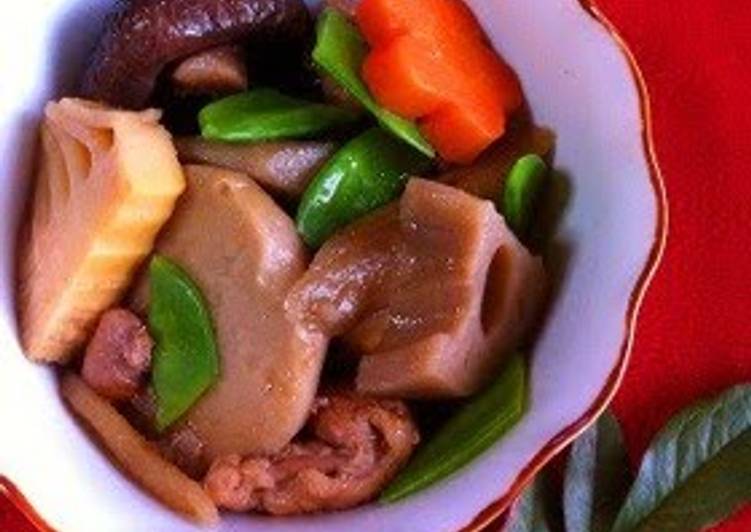
We hope you got insight from reading it, now let's go back to no mess-ups! chikuzen-ni/onishime (japanese stew) - perfect for new years and picnics recipe. You can have no mess-ups! chikuzen-ni/onishime (japanese stew) - perfect for new years and picnics using 18 ingredients and 8 steps. Here is how you cook it.
The ingredients needed to cook No Mess-Ups! Chikuzen-Ni/Onishime (Japanese Stew) - Perfect For New Years and Picnics:
- You need 1 of thigh Chicken thigh.
- Use 1/2 of Burdock root.
- Prepare 1/2 of section Lotus root.
- You need 6 of Satoimo (taro).
- Provide 1/2 of Carrot.
- You need 1/2 of Konnyaku.
- Prepare 12 of Dried Shiitake Mushrooms (small).
- Provide 100 grams of Cooked bamboo shoots in brine.
- Provide 12 of Snow peas.
- Provide 2 1/2 cup of ○Dashi stock.
- You need 200 ml of Water used to reconstitute the shiitake.
- Use 6 tbsp of ☆Sake.
- Prepare 1 1/2 tbsp of ☆Sugar.
- Get 1 tbsp of ☆Mirin.
- Take 3 tbsp of ☆Soy sauce.
- Use 2 tbsp of ☆Dashi soy sauce (soy sauce premixed with dashi).
- Get 2 tbsp of ☆ Usukuchi soy sauce.
- Prepare 1 of Vegetable oil.
Steps to make No Mess-Ups! Chikuzen-Ni/Onishime (Japanese Stew) - Perfect For New Years and Picnics:
- Cut the chicken into bite-sized pieces and peel the taro. Shave off the burdock skin with the back of your knife and then cut into chunks about 5 cm long..
- Peel the lotus root and the carrot, then cut into pieces 8 mm thick (It will be prettier if you use decorative cuts on the lotus root and cut out the carrots using a flower mold). Rope-twist the konnyaku. You can do this by first slicing the konnyaku into slices that are 8 mm thick, and then cutting a slit down the middle of each piece. Insert one end of the piece into the slit and pull to get a twisted konnyaku..
- Wash the bamboo shoot and cut into bite-sized pieces. Reconstitute the shiitake with 1 cup of warm water. Remove the veins from the snow peas, then blanch them in salt water..
- Parboiling - Boil the burdock for about 10 minutes in plenty of water. Then add the lotus root and the bamboo shoot and boil for another 5 minutes. Skim off the scum occasionally..
- In a separate pot, parboil the konnyaku in boiling water. Marinate the chicken in 1 tablespoon sake and 1 tablespoon soy sauce (both not listed)..
- Heat some oil in a pot, then cook the chicken pieces skin-side down first..
- Add all of the prepared ingredients (except the snow peas) into the pot, then add the dashi and the shiitake water and let it come to a simmer. Cover with a small lid that sits right on top of the food (called an otoshibuta or a drop lid; you can make one with aluminum foil) and simmer for about 15 minutes..
- Add the ☆ seasonings and simmer some more. When you can easily stick a skewer through the taro, turn off the heat. Serve in a bowl, sprinkle on the snow peas, and you are done!.
Chikuzenni is an ordinary Nimono dish (boiled and seasoned vegetables) for everyday, but also a big part of Osechi Ryori, Japanese New Year's cuisine. Chikuzenni (筑前煮) or Nishime (煮しめ) is a classic Japanese dish often served on New Year's Day. This dish is made of root vegetables and chicken that are simmered in dashi, soy sauce, and mirin. My mom used to make it quite regularly because it was my family's favorite type of simmered dishes. Simmered in a savory dashi based sauce, Nishime is a classic one-pot vegetable stew to serve in Osechi for the Japanese New Year celebration.
If you find this No Mess-Ups! Chikuzen-Ni/Onishime (Japanese Stew) - Perfect For New Years and Picnics recipe helpful please share it to your friends or family, thank you and good luck.


Post a Comment
Post a Comment